
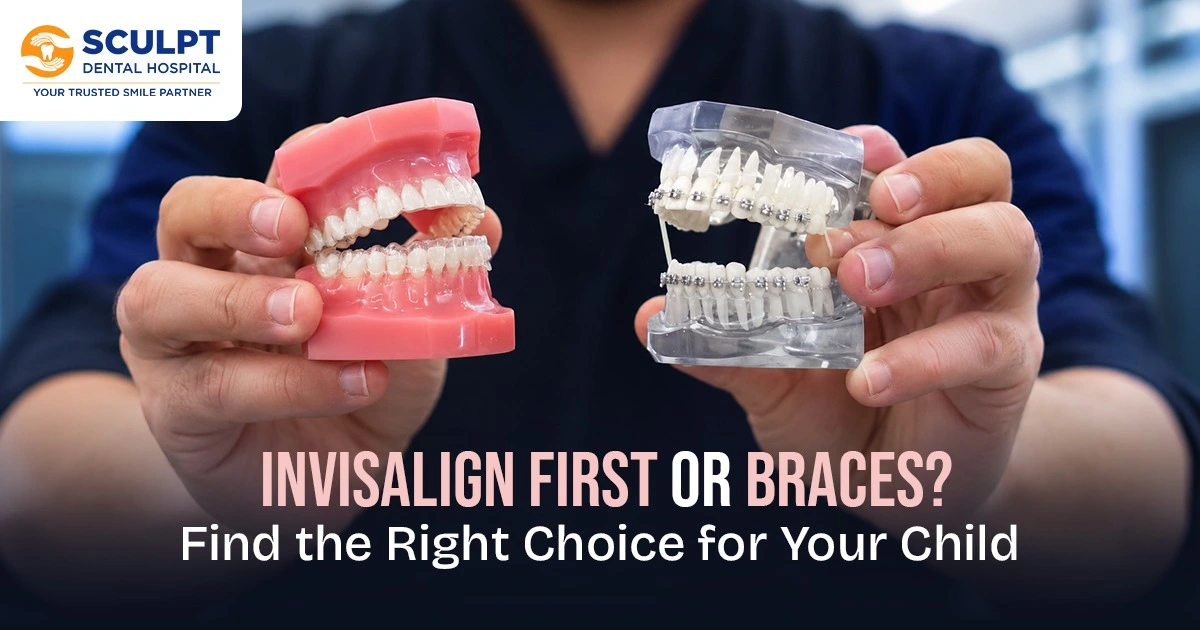
Choosing orthodontic treatment for a child can raise several questions for parents: Is Invisalign First better than braces? Is it suitable for growing teeth? Will my child be able to wear removable aligners consistently?
Invisalign First Treatment in Chennai is designed specifically for growing children and can help address certain early orthodontic concerns such as crowding, spacing and narrow dental arches. Traditional braces, meanwhile, remain a proven option for a wide range of alignment and bite problems. The right choice depends on your child’s dental development, orthodontic needs and ability to follow treatment instructions.
What Is Invisalign First for Children?
Invisalign First is a clear aligner system designed for growing children, particularly those in the mixed-dentition stage, when baby teeth and permanent teeth are present.
According to Invisalign, the system is designed for children approximately 6 to 10 years old and can address concerns including crowding, spacing and narrow dental arches.
Instead of metal brackets and wires, Invisalign First uses a series of customized, removable aligners. This allows children to remove their aligners when eating and during brushing and flossing.
If you are exploring Invisalign First Treatment in Chennai, the first step should be an orthodontic assessment to determine whether clear aligners are appropriate for your child’s specific needs.
For parents who want to understand the treatment in greater detail, Sculpt Dental Hospital’s guide on what Invisalign First is and how it works provides additional information about the treatment process.
How Do Traditional Braces Work for Children?
Traditional braces use brackets attached to the teeth and wires that apply controlled forces to gradually move teeth into better positions.
Because braces are fixed to the teeth, children cannot remove them during meals or accidentally forget to put them back. This can be particularly useful for children who may find it difficult to follow a strict aligner-wearing routine.
Braces can also be used to treat a broad range of orthodontic problems. However, the most appropriate appliance depends on the child’s individual dental condition and the orthodontist’s assessment.
Invisalign First vs Braces: What Is the Difference?
Understanding the practical differences can make the decision easier for parents.
| Feature | Invisalign First | Traditional Braces |
| Appearance | Clear and discreet | More noticeable |
| Removable | Yes | No |
| Eating | Aligners are removed during meals | Some foods may need to be avoided |
| Oral hygiene | Aligners can be removed for brushing and flossing | Requires cleaning around brackets and wires |
| Comfort | Smooth aligner surfaces | Brackets and wires may cause irritation |
| Compliance | Requires consistent wear | Fixed to the teeth |
| Orthodontic suitability | Suitable for appropriately selected growing children | Suitable for a broad range of cases |
| Daily responsibility | Child must wear and care for aligners | Less responsibility for appliance placement |
Neither option is automatically better for every child. The decision should be based on clinical requirements rather than appearance alone.
What Are the Benefits of Invisalign First?
1. A Discreet Treatment Option
One of the most noticeable advantages is the appearance. Invisalign First aligners are clear, allowing children to undergo orthodontic treatment without the visible brackets associated with traditional braces.
This can be particularly appealing to children who feel self-conscious about wearing orthodontic appliances.
2. Easier Oral Hygiene
Because Invisalign First aligners are removable, children can take them out to brush and floss their teeth.
This can make maintaining an oral hygiene routine more straightforward than cleaning around fixed brackets and wires.
The official Invisalign information for children also highlights the removable design as a benefit for brushing and flossing.
3. Designed for Growing Smiles
Invisalign First is specifically designed around the needs of growing children. It can be used during Phase 1 orthodontic treatment to help address developing concerns while the child’s teeth and jaws are still developing.
You can also read Sculpt Dental Hospital’s detailed resource on how Invisalign First can help with early orthodontic issues to learn more.
4. No Brackets or Wires
Some children may prefer clear aligners because they do not have metal brackets or wires that can rub against the cheeks or lips.
The smooth design may make the treatment experience more comfortable for some children.
5. More Flexibility During Meals
Children remove Invisalign First aligners while eating, allowing them to maintain a relatively normal diet without the same appliance-related food restrictions associated with some types of braces.
However, aligners should be cleaned and replaced as instructed after eating.
What Are the Benefits of Traditional Braces?
1. They Remain Fixed
A major advantage of braces is that they stay attached to the teeth.
Parents do not have to remind their child to put the appliance back after meals or brushing. This can be helpful for younger children who may struggle with responsibility for removable aligners.
2. Effective for Many Orthodontic Problems
Traditional braces have been used for decades and can address many different tooth alignment and bite problems.
For children with more complex orthodontic requirements, a fixed appliance may be recommended depending on the orthodontist’s assessment.
3. No Aligner-Wear Compliance
With removable aligners, consistent wear is an important part of treatment. Braces eliminate this particular concern because the appliance remains on the teeth throughout treatment.
4. A Well-Established Treatment Approach
Traditional braces remain an important part of modern orthodontics and can be an excellent treatment choice when they are appropriate for a child’s condition.
Which Is Better: Invisalign First or Braces?
There is no universal winner between Invisalign First and braces.
Invisalign First may be suitable when:
- Your child is in the appropriate stage of dental development.
- The orthodontic problem can be managed effectively with clear aligners.
- Your child can follow instructions consistently.
- Your child prefers a discreet treatment.
- Easy access for brushing and flossing is important.
- Your orthodontist recommends clear aligner treatment.
Braces may be suitable when:
- The child needs a fixed orthodontic appliance.
- The orthodontic problem requires movements better managed with braces.
- Your child may frequently remove or lose aligners.
- Consistent aligner wear could be difficult.
- Your orthodontist considers braces more appropriate for the case.
The best decision should come after an examination rather than choosing an appliance based solely on its appearance.
At What Age Should a Child See an Orthodontist?
Parents often assume that orthodontic treatment should begin only after all permanent teeth have erupted. That is not always the case.
The American Association of Orthodontists recommends that children have their first orthodontic check-up by age 7. An early evaluation does not necessarily mean your child will immediately need braces or Invisalign. Instead, it gives the orthodontist an opportunity to monitor dental and jaw development and identify potential problems early.
For parents in Chennai, an early consultation can be particularly useful when you notice crowded teeth, difficulty biting, protruding teeth, crossbite or unusual spacing.
Is Invisalign First Suitable for Every Child?
No.
Although Invisalign First is specifically designed for growing children, not every child is automatically a candidate.
The orthodontist needs to evaluate the child’s dental development, bite, tooth position and overall orthodontic requirements. The child’s ability to wear and care for removable aligners should also be considered.
Sculpt Dental Hospital provides more information about eligibility and requirements for Invisalign First Treatment, including factors that may influence treatment suitability.
The official Invisalign guidance also explains that Invisalign First is intended for growing children and can address a range of developing orthodontic concerns.
Why Is Compliance Important With Invisalign First?
This is one of the biggest factors parents should consider.
Unlike braces, Invisalign First aligners can be removed. That is convenient, but it also means children need to remember to wear them according to their orthodontist’s instructions.
If your child frequently removes the aligners, forgets to put them back or does not care for them properly, treatment may not progress as planned.
Parents can make compliance easier by creating a simple routine:
- Keep the aligner case in a consistent location.
- Remind the child to put the aligners back after meals.
- Encourage regular brushing and flossing.
- Clean the aligners according to professional instructions.
- Attend scheduled orthodontic reviews.
Sculpt Dental Hospital currently advises wearing Invisalign aligners for approximately 20–22 hours per day, removing them for eating, drinking except water, brushing and flossing.
How Does Invisalign First Treatment in Chennai Begin?
The treatment journey usually starts with an orthodontic consultation.
During the assessment, the dentist or orthodontist evaluates your child’s teeth, bite and dental development. If Invisalign First is appropriate, digital records can be used to develop a customized treatment plan.
At Sculpt Dental Hospital, the Invisalign process includes consultation, digital scanning, customized treatment planning, fitting and regular progress monitoring.
You can learn more about the broader Invisalign Treatment in Chennai options available at Sculpt Dental Hospital.
What Should Parents Consider Before Choosing?
Instead of simply asking, “Are Invisalign First or braces better?”, consider these five questions:
1. What is my child’s orthodontic problem?
Crowding, spacing, bite problems and arch development may require different treatment approaches.
2. How old is my child?
Age matters, but dental development is equally important. Invisalign First is designed specifically for growing children.
3. Can my child follow instructions?
If your child is responsible enough to wear and care for removable aligners consistently, Invisalign First may be worth considering.
4. Does my child prefer a discreet option?
Clear aligners can be much less noticeable than traditional braces.
5. What does the orthodontist recommend?
This is ultimately the most important factor. A professional assessment can determine which treatment is clinically appropriate.
Invisalign First vs Braces: A Simple Decision Guide
For parents looking for a quick answer:
Choose Invisalign First when: your child is a suitable candidate, can follow aligner-wearing instructions and you prefer a discreet, removable orthodontic option.
Consider braces when: your child needs a fixed appliance, may struggle with aligner compliance or has orthodontic requirements for which braces are more appropriate.
The goal should not simply be to choose the newest treatment. It should be to choose the right treatment for your child’s developing smile.
Frequently Asked Questions
Is Invisalign First better than braces for children?
Invisalign First is not universally better than braces. It can be an effective option for appropriately selected growing children, while braces may be preferable for other orthodontic needs. An orthodontic assessment is essential before choosing treatment.
What age is Invisalign First suitable for?
Invisalign First is designed for growing children, particularly those around 6–10 years old. However, age alone does not determine eligibility. Dental development, bite and individual orthodontic needs must also be evaluated.
Can children eat normally with Invisalign First?
Yes. Invisalign First aligners are removable, so children can take them out while eating. They should then clean their teeth and replace the aligners as instructed by their orthodontist.
Do braces work better than Invisalign First?
Not necessarily. Braces can be effective for a broad range of orthodontic problems, while Invisalign First is designed for growing children with appropriate treatment needs. The better option depends on the individual case.
How long should children wear Invisalign First?
Children should follow the wear schedule prescribed by their orthodontist. Sculpt Dental Hospital currently recommends approximately 20–22 hours of daily wear for Invisalign treatment.
Conclusion
The choice between Invisalign First and braces for children should be based on dental development, orthodontic needs, treatment complexity and your child’s ability to follow instructions.
Invisalign First offers a discreet and removable option specifically designed for growing smiles, while traditional braces continue to provide a dependable fixed treatment option for many children.
If you have noticed crowding, spacing, bite problems or unusual tooth development in your child, an early orthodontic consultation can help you understand the available options.
Give Your Child the Right Start for a Healthy, Confident Smile
Considering Invisalign First Treatment in Chennai for your child?
Sculpt Dental Hospital offers personalized orthodontic care to help parents understand whether Invisalign First, braces or another treatment approach is appropriate for their child’s developing smile.
Don’t wait until a small orthodontic concern becomes a bigger one. Book an Appointment with Sculpt Dental Hospital today and schedule a consultation for your child’s smile.